Wednesday, December 13, 2006

Comfort Zone


1.The state of the art. Visual mood board.


2. Cover, soft comfy courdory.


3. Stitching Detail


4. Contents, couch illustration to divide sections.


5. Red spread, some type overlay.


6. Red spread 2


7. Brown spread showing dialogue.


8. Brown spread 2 showing treatment of footnotes / reflective thoughts.


9. Blue couch 1, how fiction typography is treated as evidence


10. Aftermath left in the living room.


1.
The book is about couches. It organized around two forms of content related to couches. The first form deals with ideas of comfort which I will refer to as ‘fact’ and the second form of information tracks discomfort in a relationship between three characters: him, her and and Natalie which I will refer to as ‘fiction’. Throughout the book there is an interplay between the two sections of fact and fiction to play off and build on each other.

The cover itself is comfortable, made of a red courdory material. I felt like the most dominant character in the book should be ‘She’ so the red material is representative of her. Ribbon was used to divide sections. It was stitched in the margins to drive home the idea of fraying and reading between the seams.

This book has 3 different sections focused on a single couch; a red couch, brown couch and blue couch. All of the chapters incorporate the fact and fiction content areas. Each section creates a mood surrounding the particular couch through photography and content. The fact is divided into: frame, support and appearance. The photos act as diagrams which explore and help to tell the story. The type was treated in a diagrammatic manner as well.

The fiction establishes ideas of a relationship through: dialogue, and reflective narrative mainly. It uses footnotes to show different version of a particular scene. It reads somewhat like a movie script.

Both the fact and fiction and the story play off and help to build on each other through all of these devices.


2.

The whole conception of the book has been an evolutionary process. It started off as simply a book on couches, but trying to steer away from a chronological approach. I wanted the book to be a tactile experience, and play with the materials a couch is made of – wood, fabric, metal etc. I achieved this in the actual book by having ‘tactile looking’ photos of the couches which explore the materials a couch is made of. Also, I thought of ideas of comfort and value in a couch. Plus I considered things like location of a couch. When consulting Wikipedia, I read about how contemporary society treats the couch and terms like couch potato and how it is incorporated to our society. At this point I was inspired by Frued and ideas of stream of consciousness. This ties into couches as one use of a couch is in the psychiatrists office. This got me thinking about free association and how my book might not include any couches, rather, be this free associative experience.
Then, I realized I needed some content for my book so I went on couch photo mission. In total I took about 1000 different photos of couches, which I forgot to document in my process, of 7-10 different couches, approximately 100 each. If I actually used the couch in my book I have around 300 shots for each couch. This was also a cool point in my process. When shooting the couches that I actually used in my book I would revisit them to take more photos. Each time I revisited, I came across something new but unzipping a cushion or removing it from the couch all together.

At this point I had done a lot of reading and compiled but not synthesized my ideas of comfort from Witold Rybczynski’s book Home, collected a ton of visual sources (most of which I did not actually use) like couch illustrations, photographs of extravagant couches, and old black and white photos of couches. Then I went through the process of sorting my photos and making connections between them through juxtaposition. This is where the establishment of a mood for each couch came in. I really enjoyed exploring the couches so I wanted the viewer to have a similar experience. The investigation process seemed to work better with recycled couches as they told more of a story. This is where the story part came in. I started to think of the stories which the photos told and where, she, he and Natalie were established. I started to establish the content of the story myself but was finding it extremely difficult. So, I sent a package to my friend in creative writing consisting of: juxtapositions I had made with images, Witold’s ideas of comfort, some extra reading I had done on Freud, (I felt like the male character should be similar to Frued), samples of the writing style I like, and the beginning of the story and basic plot. That is the beginning of the end of the evolution of my concept.

3.

Structuring Information
Structuring the information was quite the challenge. I had two distinctly different (yet related) forms of written content, the fact and the fiction. The way I treated this was dividing the spread, left and right pages, into ‘fact area’ and ‘fiction area.’
The fact page usually contained a highlighted element relating to the fiction area. The fiction page was at times related to the words on the adjacent page. This is consistent for approximately 70% of the book. There are instance where the fiction visually encroaches on the fact page and visa versa. The typographic treatment of the fact is a sans serif, while for elements related to fiction it is serif and some a grungy display type for the dialogue. I added some tertiary levels of information in the form of highlighted dictionary definitions which need to be revisited as currently they don’t read but they will function to play off and build on content in a diagrammatic way.

Imagery.
The imagery used was consistent to show an investigative process. There were medium shots, straight on just showing the couch. There were angled shots showing different perspectives of the couch. There were closeup shot of the couch focusing on a particular element of it. There were also macro shots of the couch, magnifying certain elements of the couch. These types of shots focus on detail, like a cigarette, or fraying portion of fabric. There were also even some abstracted photos of the couch. In each section, there was extreme attention to light and colour. The red couch had warmer tones to represent the she character. The brown couch was tinted slightly grey to create stark imagery because to expose the idea of Natalie. The blue couch was colder to represent the male, ‘he’ character.


4.

Time was a killer during this project. There is lots I want to expand on, hope to expand on for grad show.

I will be adding more diagrammatic information to my book to build on both the ‘factual’ and the story ‘portion.’ Diagrammatic elements for the ‘factual’ will include: how to achieve maximum comfort on a couch, more exploring the process of making and couch, the nuts and bolts of it, activities that are performed on a couch, how to sit ergonomically. I would have liked to include diagrams of how people function in spaces in relation to location of a couch

I would like to make my book appeal more to the senses. I would like some of the pictures to be ‘scratch and sniff,’ to further engage the reader and establish mood. I don’t know if this is possible but I think it would be cool to have element like the pizza smell like pizza etc. Plus I may want to incorporate actual fabric from the couches themselves but that would be extremely difficult because I would have to strip them. I might want to go on a fabric hunting mission to see if I can match fabrics. It would be cool to coat the ‘underside’ of the pages (what is currently white) with the actual material from the couch.

Technically, I would have had someone else physically put together my book. I am happy with the aesthetic I have started to establish but it would have been far better to have had someone else do it. I want to exploit the materials I am using to create the book and play off the idea of reading between the seams or exploring what’s in the seams of couches, hence the stitching in the margins. I want to really try and work the materials into each portion of the book. I want it sewn into 3 different sections using thread corresponding to the sections. This would have made my book not so flimsy.

5.

First, I would say, definitely take book first semester if you have any hopes of putting it in the grad show. Learn everything you possibly can before then class. If possible, I would even suggest taking it in the summer (over the span of atleast three months). There is a lot to keep in mind when taking book so here goes. I would say when taking book you have to have extremely good writing skills, or know someone who does to set the right tone of your book. Plus you have to be able to write really quickly because 3 months is really not a lot of time. It is quite hard to be establishing content, while ‘designing,’ although they sort of go hand in hand. From my personal experience, the content creation has been a collaborative effort. I sent my creative writing friend a 30 page manuscript an which she edited and helped me develop into what I wanted.

There is also the technical side of book. Technically, I am very messy so my books tend to lack in that department. If you are good technically, or enjoy that sort of stuff you can produce really stunning work.

You should have a good working knowledge of classical books and things like structure of a book, contents, proportion for layout., book fundamentals. In contrast to you should also familiarize yourself with experimental books. These books can be an asset consider when making your final book decisions.

I would definitely suggest taking book, first semester with no other practicum’s.

WHAT I KNOW FOR SURE


Images:
a) The cover, simple.
b) 35 packages of thinsation cookies.... yummm.
c) You get what you give.
d) Only two things are sure in life: birth and death.
e) Shocking!
f) When you write with your non-dominant hand, you are more truthful.
g) Music triggers memories.


1. A Character Sketch of the Book:
My book is a collection of responses to the question, "What do you know for sure?" This straight forward question, one my dad used to ask me when I was a kid, has triggered many different types of responses: factual, hopeful, philosophical, funny, common, serious, inspiring, thought-provoking...
With so much variety in style and subject matter, my book is visually very simple; all of the responses have their own spread(s) and the majority are complimented with an illustration. Each of the spreads uses white space in order to create more importance and to separate them from the others. Every response is treated individually while retaining a certain level of consistency with the others. The book does not have to read front to back, rather each response can be read on their own.
It is also important to mention that contributors are listed at the back of the book and not with the responses themselves. Each response has a number, which you can refer to at the back for the contributor.
The book is relatively small (5.5" by 7.5") and is more personal that way. Many of the responses are only one to ten sentences and would get lost in a larger space (as I wanted to keep each separate).

2. The Evolution of the Project:
My idea to design a book that would express people's response to "What do you know for sure?" came to me when I was thinking of a way I could avoid the typical coffee table book. I wanted this project to be personal and meaningful - a collection of thoughts rather than facts (though, I suppose what I asked, ironically, is "What is fact?"). I wanted this book to be one I could read over and over and learn something new or reinterpret every time. This idea remained constant.
Visually, my concept has changed greatly. My plan was to create visually what I have received - a diverse collection of text (and some images) in terms of what they were communicating through subject matter, tone of voice, and complexity. I wanted to create a more eclectic look, using a variety of images (illustration, photography, scans, vector creations, etc.) and text (typefaces and handwriting). The image in my mind was close to a scrapbook of newspaper clippings, notes, ticket stubs, pressed flowers and smudges or stains.
Another idea I had in the beginning was to approach a wider audience with my question. Because my dad was always questioning children about life, I would have loved to get children's responses and to contrast that with responses from older people. I would have been interesting to see the difference between those of a young child, a twenty-something, a middle-aged, and a senior. Time and legalities kept me from taking this road, but I am happy with the group I did survey (ages range from 18 to 31).

3. Making Choices:
An important decision I made refers to the previous section, specifically the imagery. Until very recently, I was collecting and using the various types of images described above. However, the spreads looked disorganized and unrelated. Again referring to the diverse nature of the content, I felt I had to keep the visuals more consistent. Maybe that more ephemeral quality would have worked if I went further than I did. (Perhaps if I had a greater variety and more of it?) In the end I switched over completely to an illustrative approach, which, for the exception of a few, I did myself. While many are done in different styles, I think they work well together and help unify the book.
The second important decision was regarding structure. Another idea that I had before I started was to somehow categorize the responses by topic or tone for more structure. Grouping responses according to who wrote them (ie. their age) also crossed my mind. Though in the final book they were not sorted into sections, the order was still a large consideration. In the case where someone would read it front to back, the responses had to flow, conceptually and visually.

4. Compromises:
If time and money weren't an issue, I really would have liked to include all of the responses that I received and more (I had to cut some and I would have liked to ask more people); everyone had such great responses that deserved more effort than I gave them. Some responses were so hard to illustrate and I feel at times the ones I illustrated may not have quite worked as well as they could. I also would have liked to do a better job on printing and binding. Visually, both inside and out, I am not thrilled how my book turned out.

5. Pleasures and Frustrations:
Although I was am not happy with my final project, I loved this class. I think book design is very challenging and there is a lot of work. Think of how much work goes into a poster, a brochure or letterhead and multiply that by 100 (or how ever long your book is) then add the printing and binding! But I think the experience is worth it and knowing that you can actually make an entire book from scratch is sweet and satisfying.
As far as what kind of book to make, ensuring that it's something you are deeply interested in is very important. Thankfully I chose a topic that I loved, right to the very end, and never got tired of reading the same text or seeing the same images over and over. Doing something personal as opposed to a generic topic is very rewarding.

VER

Mo Can't Upload - here is hers.


1.

Entitled Ver, the book is a fictional story of a proposed instance of time. It is a story about a place in time of an invented alternate reality. This instance has everything familiar to us; there are land, trees, animal and so forth. Their world functions seemingly parallel to the way our current everyday living works. However, Ver’s reality possesses certain eerie qualities that are unlike our reality.

To juxtapose, yet complement this bizarre aesthetic, my own visual interpretation was applied to the story. The entire book is highly visually eccentric, and colourful. It contains a mix of various illustrations style. Typography is clear and consistent, and carefully complements the intensity of the images.

The book is separated into 5 sections. The introduction begins with an excerpt of a story, which is vague and mysterious. The sections then follow: The Environment, The Inhabitants, The People, The Capital, The Culture, Each section describes each aspect of Ver, while also contextualizing and clarifying the introduction story.

The sections act as markers of time. It begins at 00:00 and progresses accordingly, which serve as the page numbering system. Each section, possesses its own visual aesthetic


2.

My initial concept for my book began with a research-intensive topic regarding the inadequacies of the Canadian elementary school system. This topic, although I feel the issue still needs to be address, was too rigid and did not have the flexibility that I wanted.

Because there was so much freedom in our choice of topic and approach, a completely fictional story was written. The initial concept was to have a story that responded to specific topics within pseudoscience, which included the controversial Intelligent design theory. However, I did not want it to read a journal, instead I wanted to involve the audience more. Therefore, I wrote a story about an alternate reality. I used my previous research on pseudo science, Intelligent Design, and phrenology as the foundation of the content.


3.

Initially, I wanted the aesthetic of the book to be more eerie, dark, and mysterious. I wanted to utilize a darker palette to have a more serious and melancholy mood. Opposite to that is my actual approach, one that is vibrant yet creepy. My intention of this book was to be extremely visually explosive and intense, while being grounded by consistent typography. I decided that I was going to illustrate each page with a different illustration voice than the next. This would have been highly work intensive. Therefore, it was decided that each section would have their own illustration style, which still possessed the varied eccentricity that I wanted to convey.

I also wanted to be experimental in my typographic approach. However, the story is meant to be read as if it was a short novel, therefore needed to maintain a certain consistency. I then decided that the type should always appear on the recto side of the page, and have one treatment. This is so that the audience can rely on having a consistent read. The book is meant to be perused through first by looking at the imagery, then once intrigued, the story can be read.

4.

If money or time wasn’t an issue, I would have extensively written a complete novel. Think Harry Potter series. Ideally I wanted the book to be printed in a lighter weight paper with completely matte printing. I wanted to have two versions, a hard cover version and a soft cover version. The soft cover would have an extremely detailed illustration that wrapped around. It would have been perfect bound, with a vellum wrap around. The hard cover, would be wrapped in printed canvass with the debossed word VER on it. It would have been hand sewed with a fabric slip case. For both books, I wanted to utilize different paper types for each section divider.


5.

This is the first class of which I had the complete freedom to create an ideal project for myself, one of which I was responsible for the content as well as visual approach. This resulted in a completely personal piece of work that I was completely passionate about (that I have grown strangely attached to).

I enjoyed the class highly. And although the mini exercises did distract me from my main book. I really liked doing them, and felt that I learned a lot about books, and binding in general.

I think it would be best if the book class was a full year course, where research for the main project would go on in the first term, while 3 or four mini exercises are being done. The second term is completely devoted to the design of the book, focusing more on how the book is structured; grid, typography, etc.

the essence of Mask


cover

half title


inside spread _1


inside spread _2

back cover

1) A Character Sketch of the Book:

My book “The essence of Mask” is about Korean masks that originated from a place called Hahae in the southern part of Korea. Originally there were 14 masks manufactured around the 12th century but now just 12 types remain. Only two masks were chosen for this book as a main subject. The ‘story’ in this book does not just talk about general information concerning masks but it also magnifies and discovers some hidden meanings of the two masks as seen through my perspective. The book is divided into three chapters. The first chapter is about the origins and general characteristics of masks in order to provide some background knowledge about the subject matter. The rest of chapters are about the masks’ specific features, social values and materials. In these chapters I talked about my personal impressions of how I see the masks and what significances they could be associated with in cultural and social values in Korea.

2) The Evolution of the Project:

After selecting the subject “Mask” for my book, it was hard for me to find the direction I wanted to take. Initially I was going to talk about common knowledge and information about the subject. After having a few discussions with my instructor, Reg, I got a small idea about what I should do for my book. He suggested that this book could be more interesting and act as a personal interpretation book if I voice my thoughts and impressions about the masks. Since I didn’t know about the masks very much, I initiated my research about the objects first. The challenge was to make connections between general information and my impressions about the masks. I had to modify the content and manuscript until I completed the book.

3) Making Choices:

a) FormatThe format of book was determined by the size of actual mask (17cm X 24cm). Since the rectangular shape of mask represents the proportion of human’s face, I thought it would be good to keep the same size and proportion. This format was also effective on playing images in spread.

b) TypefacesThe typeface I chose for the tile and chapter heading is called Albertus MT. This typeface has interesting angles on letters that is very similar with the surface of masks. For the body text, Optima was selected for readability. Even though the font is a sans serif typeface, it conveys very elegant feel of the masks.

4) Compromises:

I wanted to chose an experimental approach to the selection of paper and binding. The paper I wanted was a thin and high quality paper that conveyed the feel of an oriental book and at the same time it could print high quality photographs. I ended up choosing the pager which is okay but not exactly what I wanted. I would like to spend more time for selecting a better paper. One more thing I wished I could have done is that I would have liked to do more elaborate binding and a bookcase. The binding I did was just a basic binding method of Japanese book sewing. There was a sewing method I wanted to try for my book, but it was quite complicated to do in a short amount of time. The bookcase would be good to protect and present the book in sophisticated manner.

5) Pleasures and Frustrations:

I definitely suggest for students to take this course if students want to lean how to manage a big project like how to construct a book. I had really hard time managing the sequence of the whole process and preparation. For example, during the course I was confused as on what to do first between writing a manuscript and collecting images. Without knowing what kinds of visuals I was going to use, it was quite hard to research and write the story. By now I sort of have an idea about how I should approach a big project like this in the future. A pleasuring part of this course was learning how to bind books in various methods. It was very useful experience to know how books are actually structured. It helped me to see the other side of books instead of just reading material.

Postcard Fictions (a portrait as the lens of my own eye saw it)


Book cover front view


Texture of the suede cover


Section 1 (dark portraits and fictional autobiographies)


Section 2 (poetic diary entries)

Section divider (Postcard back, reading: "Ladies, of course, make much prettier pictures")


Section 3 (multiple narratives running together)

Section 3 - (one narrative visually "overtakes" the section)


Section 4 (diary entries continued)


Section 5 (autobiographies continued)

A Character Sketch of the Book: describe your book in general terms (what it looks like, how the information/story is organized) as if talking to someone who has never seen it.

Postcard Fictions was inspired by early to mid-20th century postcards of women. Women portrayed on these postcards appear evocative, beautiful and idealized, but they also existed at some point as real persons with a personal history. The book meditates on the connection between the photographer (who remains unseen), women depicted on the postcards and fictional author. The book weaves together multiple narratives and photographic postcard images, composing a fictional non-linear account of female lives.

Postcard Fictions has a dark green suede cover with an ambiguous vintage postcard of a woman holding a mirror. The book is divided into 5 sections arranged in a mirroring symmetrical order. The first section is a collection of dark postcard portraits of women juxtaposed with lines from fictional autobiographies. The second section consists of monochromatic photographic postcards of women juxtaposed with poetic diary entries, which were taken from the work of Roxanne M Carter (www.persephassa.com). The middle section continues to have the diary entries but has an additional text that gradually appears and takes over the pages, until it fully covers several full spreads. The text was taken from Helene Cixous’s Firstdays of the Year and is a meditation on the experience of a female author. The fourth section mirrors the second, containing full colour postcard images juxtaposed with diary entries. The last section mirrors the first, containing fictional autobiographies and dark portraits of women. In addition, two articles by and about early 20th century female photographers appear in the book before and after the middle section.


The Evolution of the Project: reflect on how the book has changed over time from its original conception.

My book has gone through several major changes during its conception. At first it was conceived to be a historical picture book containing academic articles on postcards of women from various countries and historical periods. Also, I have done some research on contemporary widely available postcards, and saw that predominantly any women portrayed on them were wearing a bikini (if any), and were rather boring, repetitive and lacking in character and expression. I decided to use images done by contemporary illustrators, photographers and artists as interpretations of postcards portraying contemporary women. Originally the book was intended to be partly a collection of research essays, partly an art project that fit with the theme.

However, I’ve soon discovered that it was too challenging to combine historical photographic postcards and contemporary illustration in a coherent way within the time constraints of the course. I have decided to make my book to be a more personal interpretation of the postcard images.


Making Choices: pick two important choices you have made concerning your book (type, format, layout, images, etc.) and talk about why you made those particular decisions.

Typeface choice:

The main portion of the book is set in Mrs Eaves. The typeface adds another female voice to the book through its distinct character and the fact that it was made by a female designer (Zuzanna Licko). Mrs Eaves sought to capture “the warmth and softness of letterpress printing that often occurs due to the ‘gain’ of impression and ink spread”.

To contrast this typeface, I have chosen to use The Sans - a clean and very legible sans serif – for typesetting Helene Cixous’s narrative.

Format choice:

The size of the book is 6.5” x 8.5”. Combined with the softness of suede cover the book fits comfortably into one’s hand and is reminiscent of a journal.


Compromises: describe some of the things (if time or money wasn’t an issue) you might have done differently and what they would have added to your book.

If time was not an issue, I would have extended the book to be around 250 pages and would have tracked down the postcard images I’ve used to provide them in higher resolution. I would have worked in collaboration with one or two authors to compose the text for this book, instead of borrowing it from already existing literary works. Also I would've worked to further resolve the visual look and feel of the book and improve my typesetting and layout choices.


Pleasures and Frustrations: talking about book design in general – if you were with other students thinking about enrolling in a book design course (not necessarily this course) what would you tell them to expect and what to consider before they make their decision.

Book design is a very important course to take for any student and especially for those interested in print. This course makes the student draw on a variety of skills developed in and outside of the design program and apply them to an extensive project. Book design allows the student to create stories, which is one of the most fascinating and complex aspects of design practice. It also allows the student to experiment with materials and learn traditional skills of bookmaking, such as sawing and binding. For people interested in reading books it is also an enriching experience, because it makes you consider the history of books and the logic behind their structure.

The course is very challenging because it focuses on a single extensive project. Some of the challenges are maintaining a fresh perspective on the project and dividing one’s focus between the conception of the book and its design. The latter is a delicate balance that needs to be maintained in order to create a successful piece. Generally, many frustrations and challenges present in any design project appear when working on a book and are increased two- or threefold, since it’s an extensive project. These include both creative and technical issues. However, the rewards present in any design project are also there when making a book, and are increased due to the scope of the project.

Since books are a form of art, many challenges present in an art project appear when making a book. These include its open-ended nature and multiple possible ways of telling the same story (not mentioning that one needs to choose which story to tell in the first place).

Whether deemed successful or unsuccessful upon completion, making a book is a journey which is definitely worth embarking on.

Tuesday, December 12, 2006

Tough Love: Memoirs of a Gymnast

Okay. So I went home and was about to upload some pictures from my book when I realized my batteries were dead and my cord was in the labs. So here are my spreads from inDesign. But I'll be uploading images of my final book (bound) later on.


Cover (front and back)


This spread talks about my love for gymnastics stickers. When I was scanning one of my sketchbooks, this sticker fell off and so I scanned the back as well.


We used to decorate our hairclips with nail polish.


My massive gymnastics magazine collection.


Grips for bars


Gymnastics story page.


1. My book is about gymnastics, but not the glamorized version of it (competitions, exhibitions, etc) it's the every-day aspect of gymnastics - it's the practices that you have to go to, the commitment, the dedication and the passion for the sport. I wanted to make the book slightly personal, but since everyone's experience of the sport is a bit different I distanced myself away from it a bit. Within my book there are basically 2 types of narrative. The primary narrative is meant to give a really personal in-depth look at the sport from a gymnasts perspective. It talks in a first-person narrative, and is basically just me talking about my experiences as a gymnast - the feeling of flight, the hardship & pain, and the everyday objects that I was surrounded by.The second narrative is coloured in pink pages and basically talks about other gymnasts experiences and different aspects of the sport that I didn't get the chance to go through (i.e. going to the olympics). This narrative gives people a broader feeling of what the sport of means to other gymnasts.

2. This book project has gone through a HUGE overhaul over the course of the term. At first I was going to do a book about prisoners and the prison system, but then I realized I didn't quite like that subject as much as I would need to make the book. Then I changed to gymnastics thinking it would be a lot less research and more just concentration on the book, but because of my long life experiences, it made it very easy for me to conceive of a book structure and then suddenly think of another, and another, and another. The first structure I was going to use was by level (recreational, pre-competitive & competitive), then I decided to structure the book by season (pre-season, pre-competition, & competition). Then I was going to have 3 narratives - the technical narrative, personal narrative, and the psychological narrative. Then I started writing it and realized this was going to be quite the challenge and very much not what the gymnastics experience is about at all. So finally, after collecting over a thousand images for my book I went for a simple approach - simply just talking about the objects, experiences, and feelings. By doing this, the narrative came much easier and it felt much more like a casual conversation rather than a concise organized academic document.

3a) Type:
Because the layout of the images needed to be the main focus of the page, the type needed to be fairly recessive on the page. Also, because of the non-linear format of the book, I wanted to separate the two narratives and the sections so that they could be read and understood as being different things that the reader can 'dip' into. I decided for the first-person narrative to use a sans serif font - Auto 2 - in grey. Auto 2 is very dynamic typeface because it has a large family and can be set in all sorts of different ways.
The second typeface - Dolly - was used for the second narrative (the gymnastics stories). In this part of the book the image is recessed and the words are dominant. Because I wanted to give a more humanist feeling to the stories, I picked a serif font.
Another thing about the two typefaces is that they were both designed by a company called Underware Fonts in the netherlands, so they have a very unique quirky feeling. Also, because they were both designed by the same place they work really well together.

3b) Images:
When I first started the project I went home and brought back some objects, and then went to my old gymnastics club to take pictures. When I went home I found that my collection of gymnastics things were everywhere and so I found it hard to find things I wanted, but very easy to find things I didn't expect. The pictures I got back also ended up being a very 'interesting' surprise. Because the lighting in the gym was so lo, a lot of the images I took turned out to be very grainy (which was not the style if imagery I was looking for at the beginning). So in talking to Reg we decided that I should just give the book less of a 'commercial' feel, but a more personal touch to it (ref: Terry). This would allow me to use the bad photographs to my advantage (along with the photos I have from my own childhood). It also turns out that all of the ephemera I had taken worked quite well with the grainy photographs. The only pictures I used that looked a bit more professional were the photos of the objects and that was because they needed that detail and realistic feeling to them (my friend Umar also took them, and apparently he owns a much more expensive camera :P ).

4. If time and money weren't an issue, I would have probably made the book longer and written more about the objects in the book. Since a lot of my time was spent digging through all of my old things, taking photos of the objects, and editing the photographs (stylistically and retouching) to suit the book I didn't leave myself a lot of time to work on the actual writing of the book. Another thing I would change is the covers of the book along with the front and end matter. The cover was put together under a time constraint and so I don't think I really had much time to conceptualize a proper cover that would suit the book and so the figurine gymnast seemed to be the most convenient and obvious cover. I would also add things that I left because of time issues - a glossary of terms (which were supposed to be the end pages), Bibliography, Acknowledgments, etc. The binding I used to create the book was also rushed, so I think had I had more time I would have sewn the book using signatures so the book could open more easily. Other small things I would have done were typesetting the book, and finalizing the layouts within each page.

5. Pleasures and Frustrations: talking about book design in general – if you were with other students thinking about enrolling in a book design course (not necessarily this course) what would you tell them to expect and what to consider before they make their decision.
The one thing I loved the most in each project was sitting down with all of my prints and putting them together in a book. I really liked taking paper and turning them into something you could put on your bookshelf - something 'real'. I really liked designing the book, but I feel like that is something that I would enjoy doing the second time around because now I sort of know what goes into the design of the book and so my planning for the book (or any substantially large design document) would probably be much better.
If someone I knew was thinking about taking the class I would recommend it because it's a very good learning experience in terms of organizing large amounts of information and images into one concise document. Another thing about our class (specifically) is that it allowed us to be very experimental with the book and try new things. The binding demonstrations I also really liked because it helped learn about ways of improving my mock-up techniques as well as making books, boxes, etc. So basically out of all of the sections I would definitely say our section was the best in terms of what I learned and wanted to learn throughout the class (technically and through experience).

Play that Beat

1. Cover - foam pads representing the modern-day sampler aesthetic
2. Contents - Get your read on
3. Chapter marker for section three
4. A spread
5. Bound with 'Chicago pins' (screws that screw into each other)
6. Another peak inside
7. Cover shot - a few people thought I had screened it on.


1) My book is entitled “Play that Beat: The History & Culture of the Drum Machine.” The book basically informs its readers about the history and development of these instruments, where they came from and where they went. The book is divided into three sections, ‘In the beginning…’, ‘The Golden Age’, and ‘Culture’. The first section is about the origins and the early climate which led to the development of the early ‘rhythm machines’. From here it follows as pretty chronological look at the progression of things, highlighting key companies, and makes and models, as well as some musicians who have made them popular over the year. The ‘Golden Age’ chronicles the drum machines heyday in the late 70s to early 90s. This was a very prolific time for the development and advancement of the technology, as well as broadening its acceptance worldwide. The final section surrounds a few various cultural impacts that have resulting from their existence. The book is meant to appear to those who are interested in drum machines, sampling, Hip-Hop culture, and all forms of musical expression. The book was intended to not target any one particular audience, because I wanted to keep it relatively open and have a broader appeal. The book is rich with information and visuals and should be an interesting read for anyone who’s interested.

2) The overall plan for this book did not change considerably over time. It was always my intention to make it a pretty straightforward coffee table book. A lot of little things came and went throughout both the planning and execution phase, but nothing major (except for one thing, see #4!). I stuck to my original plan pretty well. The only thing that changed considerably was the ‘culture’ section of book. I had originally planned for this section to be much more in-depth. Time constraints were somewhat of a factor, but more so it was the fact that the manuscript had already ballooned to well over ten thousand words before even getting to section three! I figured for all intents and purposes at this point it was just as well to leave it as it appears in the final book, much more concise and to the point. Hopefully I can expand this section in the future to include more commentary on things like the debate over whether the sampler is a musical instrument, because I find this to be a fascinating topic.

The only other thing that changed really was that I was always planning on doing a graphical time line showing the development over the last 50 years or so. This just proved a little to time-consuming and complicated and in the end just got cut. But again, something that can definitely be revamped for book V2.0.

3) Format: I chose this particular format (~9x12) because this type of elongated proportion is traditionally how the early rhythm and drum machines were proportioned. It is basically an homage to classic machines such as the TR-808 and others who helped redefine entire musical landscapes. This proportion also worked very well with the binding style I chose, as well as giving me generous amounts of space to work with the design.

Type: I chose Adobe Caslon as the body copy for my book because of its excellent readability. I have originally not wanted to go with something so traditional and classical as far as book typefaces are concerned, but I had to reason with myself because there ended up being a much more epic manuscript than I had originally envisioned. Working through this book would probably not have been as enjoyable with a sans serif face in the end, although I had not originally intended it to be this way.

I chose a typeface called Apex new from the Village Foundry as the compliment to Caslon. They have a lot of really nice typefaces that are very hip, yet very versatile. I’ve received a lot of good feedback about Apex in this book, I felt it helped give it a kind of mechanical-yet-somewhat organic feel that the book needed.

4) A couple people knew that the original plan for my book was to have a sort of operational drum machine actually be part of the cover. I.e the sampler pads that are on the cover could actually produce a sound electronically when pressed. I really wanted to do this and spent quite a lot of time in the early phases trying to plan this out. I looked into the various ways I could produce the sound, where I could place a small speaker and where the battery would be. I had planned on adapting the sort of mechanisms that are used in recordable greeting cards, and hooking them up to the pads to trigger sounds I would record onto them. This would more than likely would have worked, however it was proving to be fairly expensive as that kind of technology was around $5 per sound module, and then you had to add the rest of the things like the speaker, wiring, battery, etc. In the end I just decided that it would be too time-consuming to produce, because it would have taken probably just as long to execute this as it did the book itself, so I made the choice to abandon it for now. The comprise was that I plan on making a case for it next semester, similar to the one Reg demo-ed in class, that when opened will trigger a small audio clip. This will be much less difficult to pull of as it requires simply rigging up the recordable greeting card mechanism to the hinge of the box and wiring in a new speaker. Plus I think it will be a really great addition to my table at grad show. If people appreciate the clever, gimmicky kind of things as much as I do it should turn out ok.

5) The advice I would offer to prospective students would be to plan and get to work as soon as possible. It really seems to sneak up on you, and it is such an involved process that it’s difficult to do in a short period of time, thus planning ahead and starting early. I would also advise ensuring that they pick a topic that they feel passionately about, something that will keep them going on it for weeks and months. I feel it was also very important to envision your finished book as often as possible, so that you know what you are working towards. Start pulling examples and influences together, and just keep them on hand for those times you are feeling uninspired to continue working on it. Plus, I feel the longer you spend envisioning your book and not actually putting it together, when the time does come to produce the book, you are more inclined to know exactly what needs to get done so that you are working towards something. Most of all though this class was about having fun, and a lot of freedom to choose exactly what you wanted to do! It was a great experience and I would definitely recommend it to other students.

Mirrors With a Memory


1) My book Mirrors with a Memory takes a look at the beginning of photography. It is a short progression of how photography evolved, but only looking at the 1800s. I wanted my book to be more artistic, then just an account of the history of photography. In order to achieve this, I used many pictures, and a variety of paper, to add texture, and a visual appeal. I wanted the book, to look soft, and did this by only using images that were black and white, or had a slight tint to them.

It is a hardcover book that is covered with a decorative paper. I used silver as a key colour, because successful photographic processes used silver iodine, and I wanted that to be represented. I decided not to have the title of the book on the front cover, because I wanted it to be more alluring so that people would not know what the exactly the book was about. This is also why I used an abstract title, to introduce its contents. This is not a history book, so I wanted to make sure that it didn’t come across as one.

2) From the beginning of this process I was unaware of how exactly I would try to achieve what I was trying to convey. I had so many different, conflicting styles of how I might go about achieving my desired effect. Originally I thought I would take the visuals of the book in the direction of collage. I considered incorporating the social aspects of how the introduction of photography affected society, and the advertisements that were produced to sell cameras to consumers. This idea was visually a lot louder then my final product. It incorporated many colours and more visuals incorporated within the type.

Another direction I had planned to take my book incorporated more of a timeline concerning the introduction of photography. I had planned to look at the 1800s to the 1950s; although I found that with this approach my book would have become to cumbersome, and gone away from what I wanted, which was for the reader to have an experience, not a history lesson.

In the end I choice a method that was much more simplistic, that incorporated both an artistic appeal as well as information to support it.

3) Two important choices that I made for my book, was the paper selection and the format I used.

Using a variety of five different paper stocks, added a visual appeal that I would not have been able to incorporate, unless I had used different textures. The colour and the style of the papers contributed to the artistic feel that I wanted to incorporate.

The format also played a roll in the book coming across as being more artistic then a history book, because of its size, and how the pages were laid out. By not having the pictures within the text, and instead, having them on separate sheets of paper, allowed the reader to be able to enjoy the photo and to be able to develop their own interpretation and appreciation for it.

4) I felt that more time would have made a big difference in the production of my book. It would have allowed the finished product to be cleaner and more put together. I plan on getting the book professionally bound, after the class is over. This will allow an additional revision, after I have received comments and criticisms from others.

If I could do something differently, it would have been, to try and decide on a clear plan earlier. I had so many different ideas, that it was difficult for me to just commit on a design and then progress further.

I also feel that one semester is just not enough time, to cover such a vast topic as photography, there is just so many different aspects to the topic, as well as varying information, that only a few months is just not enough time, to thoroughly understand this topic.

5) I enjoyed this class very much, although I would have to say that before you actually take the class it is difficult to fully understand what is involved in the making and the production of book design. One of the difficulties with book is that there are so many variables that need to be considered and planned, before the final stages of the actual completion of the project. Without actually going through these steps it is very difficult to fully understand and visualize the final product.

I also found it difficult to finalize and stick with a particular style. There are so many choices, and different things that can be done, that it is difficult to stick with one concept and carry that all the way though.

My advice to others is to just see what is out there and then decide what course of action to take. I think that it is really important to do a lot of research before you even start designing. Brainstorming is key!!

Photocopied Hearts

Front cover - mylar dust jacket with white hearts

Dust jacket detail - I printed the hearts using a Gocco.

Spread opener for Lonely Friends Club section - a photo of all my club
ephemera/souvenirs from Weimar, graph paper overlay

Spread related to stickers our club made.
The pink insert has stickers I printed out on an adhesive sheet.

Lonely Friends club zine
(There are marginal notes in pink, commenting on the text.)

Lonely Friends' Arsenal: a small booklet with different tools/supplies we used

My zine collection - inserts showing how to make your own similar zine

Some typical hipsters


1. My book, Photocopied Hearts, is a collection of personal thoughts on zines. Since I have been making zines on my own and with friends for the last few years, I thought it would be more interesting to introduce the world of independent and alternative publishing through the lens of my own personal experience. Thus, the writing is very casual in tone, and less structured, and the book is designed to feel like a zine. (It was printed on legal-sized paper then cropped.) While there are different sections related to zine collaborations, zine fairs, etc... these are not clearly defined. Instead, the use of collaged photos and illustration, as well as different kinds of paper, help pull these disparate parts together in one long, visual stream of consciousness. There are also different inserts, as well as zines (within zines) sewn into the book. The intention is to draw the reader (who is unfamiliar with zines) into the book by establishing a more personal connection with him/her through interaction, so that he/she might learn a little bit about zines through my perspective.

2. Originally I had planned on developing a book about the history/origins of zines, focusing on the different social and cultural movements that championed independent publishing and the individual voice, and essentially brought zines to where they are today. I had pictured it being more of a research-based book, which would provide anyone new to zines with a general background on the subject. But this approach seemed too removed from the subject, and I kept seeing disconnects between zine culture, which is so full of irreverent character and this Do-It-Yourself mentality, and my book, which was admittedly too serious and knowingly placing itself outside of that culture. (I think I just got into the habit of writing papers.) Since zines are very personal objects (people invest a lot of personal time in making zines, not to mention money which they’ll probably never make back), and there’s almost always a sense of the author behind the zine, I decided that taking the alternate approach – actually making my voice noticeable – would be a more thoughtful solution.

After changing directions, there were a few instances where I felt like the book didn’t fully embody my voice. The text would become too structured, and less free-flowing like a stream of consciousness, and different parts of the book felt uncomfortably separate from each other. I ended up solving this problem by incorporating more handmade elements into those sections.

3.(a) I wanted to convey the handmade quality of zines in the actual physical structure of the book. The first and most obvious solution was to print and bind the book myself (I even considered stapling it at one point) because that would heighten the sense of tactility. Imperfections in printing and sewing weren’t so much of a concern, because zines are filled with small imperfections. That’s part of their charm. I also decided that since zines often come with freebies (like small posters, paper novelties, stickers, etc...) that are stapled directly into the pages or taped onto the covers, it would be effective to create multiple zines of varying sizes and sew them into the larger book. This would also make the reading experience much more interactive and inviting.

3.(b) The typeface I chose for setting text and headlines is called Sauna, and was developed by a type design studio called Underware, in the Netherlands. It is a sans-serif with exaggeratedly round curves and straight lines – making it look fun and quirky, which is fitting for the topic and structure of the book. The typeface also has a wide range of weights, which was useful for setting larger text, like headlines or subheads. Where I had the time, I printed out outlines of the type and traced over them by hand, and rescanned them so they would feel better integrated into the book. In the section about some of my different zines, from which I draw inspiration, I also use my own writing to make side comments/notes about certain aspects I liked or found interesting about a particular zine. These small colloquial elements help to establish a closer relationship between the author (me!) and reader.

4. One thing I wish I could have added to the book is a hand-embroidered pattern of hearts along the spine. I had already drafted out the design, but, on account of time, I had to abandon that idea. That extra little bit of detailing though could have definitely made the book more curious and intriguing from the outside, and if it had been well-executed, could have made the book feel even more intimate – almost like a journal. I also would have liked to silkscreen a poster (somehow related to the title of the book), to include as a centerfold, simply because it’s always fun to have that small element of surprise (which a lot of my favourite zines have). The idea of being able to remove the poster and pin it up on a wall – like a souvenir of the book
is also nice. I probably would have created a band around the book too, with the title printed on it, small (since I didn’t put the title on the cover of the book).

5. The binding exercises were definitely helpful. A lot of the things I experimented with in terms of structure and layout helped me determine how I could approach my final project, and push it even further. Also, the pure tactility of those projects got me excited. It was really refreshing to sit down and just work with your hands. And you’d start looking at books differently. I liked the way the course was structured – sort of as discussion/workshop. And I think it would be great if, in the future, we could go through demonstrations together in class, so that everyone is making something simultaneously, in a more collaborative environment. (Like that idea for a bookbinding party!) Students would just have to know ahead of time to bring their supplies. I guess that’s part of why I thought this Blog was such a good idea – because there is so much latent potential for collaboration. Even just being in a collaborative setting can generate excitement and stimulate new ideas, and I think that’s important. Since most of the work in this class is self-directed, it can be difficult to stay motivated and passionate when you’re constantly working on your own (even if you are surrounded by a lot of beautiful books).

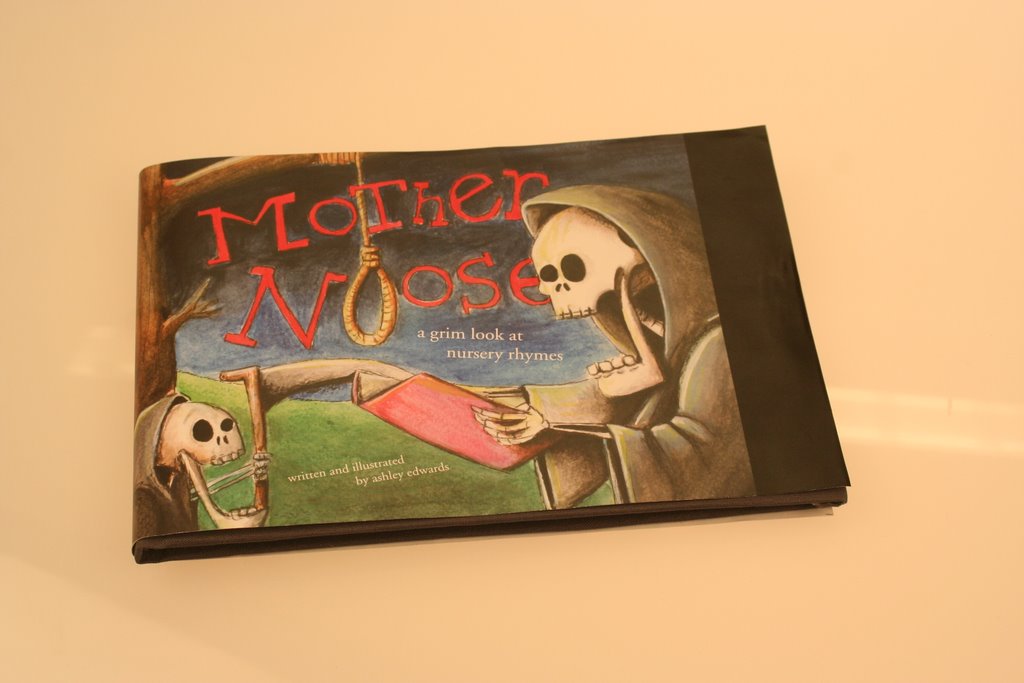
Mother Noose: A Grim Look at Nursery Rhymes


1) Mother Noose is a book about how the rhymes we have learned as children are quite brutal. The book is 5.5 by 8.5 inches and information is organized by rhyme. Seven rhymes are analyzed. The quality of the drawing is meant to resemble children’s books but at the same time be creepy. I chose to use hand written, sloppy type for the rhymes. The reason for this being that the appearance of the writing is unsettling and so adds to the creepy theme. The media used to create the illustrations were watercolours, charcoal, ink, pastels and acrylic paint. The book is formatted in long landscape spreads. The spreads alter every so often in such a way that the reader has to turn the book. This allowed for experimentation with vertical space.


2) Initially I had planned on doing a book on graffiti with a focus of the Toronto scene. A few weeks into the class I changed gears and decided to focus on nursery rhymes. As soon as I had the idea to do my book on nursery rhymes I had a vision for my book that is pretty similar to the final outcome. The only thing that I saw change was the typography. I believe my choice to use messy handwriting added to the feeling of the book.


3)A huge choice I had to make concerning my book was to cut out two nursery rhymes. Initially I had wanted to illustrate 9 but due to time constraints I could only complete 7. Had I not made this choice I would have not only gotten even less sleep than I did on this project, but also, my overall design would have suffered. Had I not stopped my design would have looked scary.

4)I would have liked to be able to finish more rhymes than I did. Though my book is lengthy if the world of children’s books, I still would have liked a few more. Also if money wasn’t an issue I would have liked to fly to Mexico to finish my book on the beach. I think that I would have made the format even longer horizontally if I had to do it all over again. As well I would have taken it to a company to scan. It would have not only saved me a lot of time but also would have made the colours more accurate and improved the overall image quality.

5) Advice I’d give people taking book would be if you want to illustrate your book make sure you have a light semester. It’s a lot of work…a lot, a lot of work. But it is also rewarding. I did find the tight timeline frustrating at times because I couldn’t take my time drawing and designing. I felt rushed most of the time and began to hate sitting and painting (which I generally love).

Julian's Book(s) - Xenopolis


1 - Xenopolis is a series of 4 novellas - Each with their our identifying colour.

2 - Without the dust jackets, the covers feature an illustration, an identifying symbol - but no actual title.

3 - The title page, along with an "introductory" paragraph which explains the connectivity of the Xenopolis books.

4 - The 'table of contents' is actually a physical map of how the stories overlap and interconnect across each book's 61 pages.

5 - Each book has it's own bookmark, to encourage the reader to mark their page and jump between the different stories. The bookmarks also line up vertically with the page numbers, which travel downwards in the gutter throughout the book.

Character Sketch:
Xenopolis is a collection of four short novellas, each of which is roughly 70 pages. They are perfect-bound, printed on laid, natural-coloured paper. Rough conté sketches in an earth-tone colour palette set the mood on the cover and in the first few pages.
The four storylines in Xenopolis are interconnected and parallel – this concept is visualized in a line drawing which serves the purpose of a traditional “table of contents.” It is clear that each storyline has its own symbol and colour in the palette, which creates a system of identification in the novellas, as text is printed in each of the four colours throughout. As one story is being read, the symbols are used as footnote characters, signaling events in the other storylines. The reader is given the opportunity to experience the stories simultaneously, by using the included bookmarks and jumping to read portions from the other novellas as they see fit.

Evolution:
I originally conceived that these four stories would be presented in one, large hardcover book. I thought I would use colours, simple illustrations and vertical positions on the pages to represent the four different class systems in which the stories take place. I was interested in doing more experimental typography – akin to that of “House of Leaves” or “Vas: An Opera in Flatland.”
The choice was made to separate the books into separate novellas because I was very interested in presenting the stories without prescriptive sequence or rank. At this point, I thought that the stories would be totally separate, and their packaging would be the major role of innovation in the design.
After meeting with Reg, and speaking at length with my brother (Will Brown, the author), I decided that showing the links between the stories was the most important thing. I reasoned that the books could be an experience to read, where the reader could decide what and how-much-of-what to read next. With this in mind, I decided that the novellas would have links and explicit interconnections that highlighted the finer touches of the stories and keep the reader guessing.

Making Choices:
One image – I made the choice fairly early on that I would be creating an illustration for the book(s). I thought that representing the city itself was a very important part of establishing the atmosphere for the stories to be read. In the opening of each story, another portion of the City is vividly described. Using these rich descriptions, I set myself the task of illustrating a “cross-section” of the City that I could use to physically map the stories onto. There would only be one image, just as there is only one city existing in the books. Then, I managed to procrastinate endlessly to avoid actually having to draw it… Weeks later, I eventually chose conté as a medium, and tried to capture the rough, energetic atmosphere in the stories. I’m quite pleased with this choice in the end.
Class-system Layout - The page layout in the novellas reflects the strict social class structure in the City. The main characters of each story have a clear position in society, from the royal advisor in “the Heathen” to the lowly rock-crushers in “the Quarryman.”
In this way, the different novellas have a “hierarchy” which is strictly for thematic purposes. They stories (whether in full text or line representation) always appear in the same top-down order throughout all the books. This creates a consistency visually, as well as a treat for the reader when they realize how the book’s layouts relate directly to the class structure of the City.

Compromises:
If not limited by time and money, I would have down several things in the books and outside the books.
- I would have designed and built a box-package which would have held the novellas in a way which thematically represented their roles in the City’s story.
- The colour silver is a feature across the four books – being able to print in silver ink (like WIRED magazine) would have been fantastic. I would have used it for titles and certain keywords within certain passages of the texts.
- I would have been more meticulous in my typesetting of the pages. As it stands now, I spent two 8-hour sit-downs typesetting roughly 175 pages of text across the four novellas.

Pleasures and Frustrations:
I took a lot of pleasure in the development of my ideas for this term project. Working with complex, fictional content really made me investigate the exact form my book would take. I enjoyed brainstorming new ways to present it, and sketching ideas for concepts that could never have gotten used. I would recommend to anyone taking a course like this to be very mindful when choosing a topic. If your design is going to have many levels of meaning, your content needs to as well.
I encountered a ton of frustrations in the actual execution of my project. At one point, I simple had a “realization of scale” of the book project I had set out for myself. Luckily, I was careful to make all of my design decisions before I carried away with the execution, so I minimized the amount of ‘backtracking.’
- Julian


1. “The Toils and Troubles of the Cauldron Bubble” is about the witch mania that began in the early fifteenth century in Europe, and ended two hundred years later along with the lives of more than nine million people. The intent of this book is to move beyond the initial, stereotypical perception of witches, by describing the conditions that made a series of systematic executions possible. These alleged Satan worshippers were the victims of a bold campaign set by the papacy to turn the public’s eye away from the sins and luxury of the Church. As a result, the witch became a scapegoat for the papacy and lightning rod for society’s fury. Another important topic of this book is the status of women at the time of these trials and the reasons for which more than 80% of the accused were women.
This book is 6.5" wide and 11" tall, to reflect the structure of a Renaissance book, considering that the witch mania occurred within that time period. The book is set in eight page signatures and is hand-sewn with an uncovered spine to reveal Coptic binding. The colour palette for the text and the illustrations is restricted to various shades of red and brown, printed on textured paper.

2. When I first started researching this topic, I hadn’t anticipated the amount of information that was available. I then realized that to be able to present an in depth view in the given time, I would have to narrow this topic to purely the European witch craze. Aside from the initial stages of research, there were not too many changes in the evolution of this project; they were rather modifications. Considering that this book presents a different look on witchcraft, I had intended to stay away from graphics or illustrations that were expected to be associated with witches. I did not want to portray the witch as one who practiced the making of potions or attended Sabbaths presided over by the Devil. Therefore, I decided to create my own illustrations and after continuously experimenting with different styles and mediums, I was finally satisfied with ink and watercolour. Although at first I had intended for the text be integrated into these illustrations, I found that I was confining the construction of the layouts to the content of the illustrations. Also, the designed pages began to take the shape of a picture book. This issue among several other obstacles, including type treatment, influenced my decision in removing the illustrations from the text and creating small pages inserted purely for the graphics.

3. a) Considering that the witch craze emerged from the Renaissance, I wanted to incorporate certain elements that would evoke the style of that time period. Hence, the book is twice as tall as it is wide and is hand sewn, with a bare spine to reveal the stitching. Although the stitching method used is Coptic binding, which dates back to the fourth century, it helps to foreshadow a time period for the viewer. Another reason for using this method of binding was the size of the book. Since the format is tall and narrow, I didn’t want reading to be an effort and turning each page an irritation. Sewing the book in signatures however and not covering the spine, creates a loose format that allows the pages to be flipped easily.

b) As previously explained, the illustrations within this book are small pages, inserted in between signatures. By removing the illustrations from the text, the layouts started to look unified and the rhythm of the text was no longer interrupted. Also, the layouts no longer appeared to belong to a storybook, which would have discredited the content and falsely portrayed the tone of the book.

4. If time were not an issue for this project, the content would have been more extensive, providing a detailed history of pagan gods and their transformation into servants of the Devil. The book would also take a deeper look into the psychoanalysis of the witchcraft accusations and the notion of the Devil and witches. Aside from the content, I would like to in the future, redraw some of my illustrations and add more. For this book, I started my illustrations using a particular style, which I moved away from half way through the project. By the end of the semester however, I went back to that same style, which I would like to keep for the entire book.

5. What I enjoyed most in these classes were the demonstrations on book binding methods or the making of boxes. It would have been very interesting to have either a full year course on book design, or a one-semester course on purely book binding. If the setup of this course was different, and the making of one book wasn’t the emphasis, it would have been very interesting to have more of the small book projects, such as the experimental binding. Also, the lectures that were given in class and the sources that were brought in were very informative and much appreciated. There are very few classes that I feel expose students to such a wide variety of sources. With only twelve classes, however, I feel as if we have only scratched the surface. There is so much to learn in this field that unfortunately the school does not provide the opportunity for. I would have liked to seen one of Reg’s workshop classes that is held outside of school, demonstrating “exotic” methods of bookbinding.

PUNK.Structured Anarchy.

Full Title. Punk. Structured Anarchy
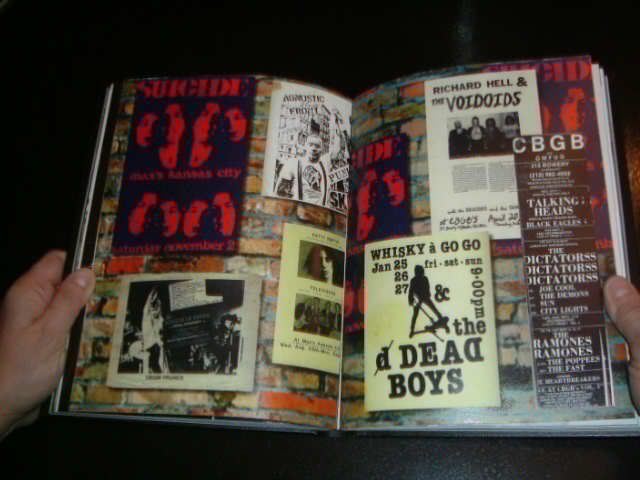
Spread One: Brick wall with original posters from the punk scene
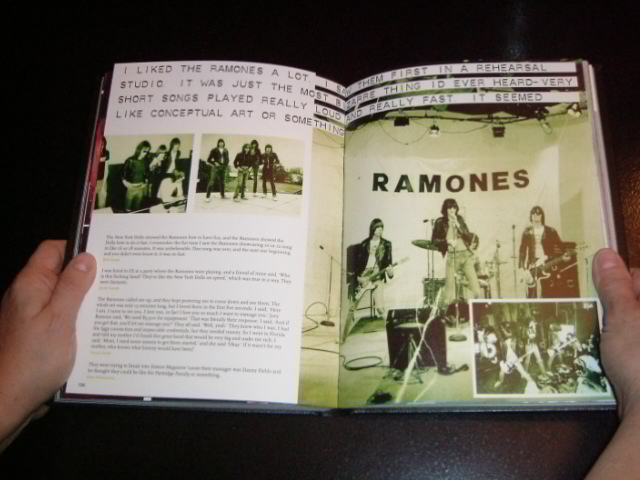
Spread Two: One column grid with a running pull quote. Full bleed.
Spread Three: An original article from 1979 about Sid Vicious' death.
Spread Four: An transcript of an interview with Debbie Harry and Chris Stein
Spread Five: All my spreads are full with images, copy, and pull quotes. Little white space needed.
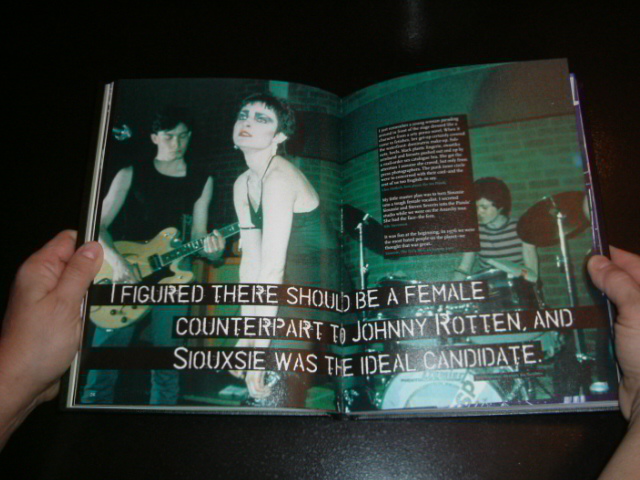
Spread Six: Minimal content in this spread. The main focus was the pull quote which says enough.
Spread Seven: The corkboard spreads come up every so often. Includes albums, tickets, backstage pass, poster, lyrics...etc.
Spread Eight: This spread only has a running pull quote and full bleed images. Minimal.
Spread Nine: There is a transcript on the side of this page but a conversation Sid and Nancy had.


1. A Character Sketch of the Book: describe your book in general terms (what it look like, how the information/story is organized) as of talking to someone who has never seen it.

I did not know much about punk music prior to designing this book. The inspiration for the design came from the sporadic nature of the music. The book is designed such that it reflects my thought process as I researched the selected subject matter. This means that the method through which I covered the various texts on the topic was used to structure the book. If I referred to a book on punk, I read segments of it that interested me the most. Those segments were then placed in conjunction with one another, resulting in a structured anarchy. The unique aspect of this book is that the different parts come in many forms including direct quotes from the band members, interviews, biographies and journal entries. Moreover, with further research, my interests in different aspects of the topic grew, and so did my desire to include the new information in my book.

Essentially, the book is set up so that it is as though I am visually describing a story about the history of punk music through the process of which I learned the material.


2. The Evolution of the Project: reflect on how the book has changed over time from its original conception.

From the very beginning of the semester, I had been doing a lot of research on a punk nightclub, CBGB. All my content, images, design concepts revolved around that topic. For some reason, I felt limited with what I could have done with it and decided to simply focus on the entirety of the punk era. With my new idea set forth, I had new ideas, which were very different from what the outcome of my book became.

I wanted the structure of my book to be in sections of the major locations, which influenced punk music. In each location, I would touch upon four to five artist and describe them in detail. Quite funny since my book took an entire turn from that initial idea. From an organized structured to a chaotic mess.


3. Making Choices: pick two important choices you have made concerning your book (type, format, layout, images, etc.) and talk about why you made those particular decisions.

One of the choices I made right at the beginning of my design was to set up the book so that it would be printed and bounded in signatures. I knew I wanted the photographs and pull quotes to be large in size and bleed onto the next page. Therefore it was essential to create it in such a way. It turned out to be a challenge in itself due to the fact that I had way too much images and copy that spread between two pages. And if you know about signature, all the pages need to match up with another page, meaning I had to slice every picture in half which took a while considering I had 132 pages.
The second most important choice I made was how to set up the content. Punk music is a huge topic on its own and I was not trying to impose that I was now an expert in the topic. I structured the content in such a way that myself and the readers can fill in the missing pieces of the puzzle. Some of the stories you could get in full while some you could not, it was all about my learning development of this new topic and how I personally interpreted it.

4. Compromises: describe some of the things (if time or money wasn’t an issue) you might have done differently and what they would have added to your book.

With an unlimited budget, I would first like to have visit New York City and London to gather more primary information about punk. I was lucky to find a lot of information but I was really hoping it would have been more personal. The pages I would have liked my book to take on were the personal stories, journal entries, and candid interview. I am just assuming that the libraries in those two locations would have a bit of what I was looking for.

Also, if I had an extra week or so, I would have liked to make a box to showcase my book in as well as a foil-stamped cover. Oh yeah, and maybe some real leather skin for the cover.


5. Pleasure and Frustrations: talking about book design in general–if you were with other students thinking about enrolling in a book design course (not necessarily this course) what would you tell them to expect and what to consider before they make their decision.

I am very glad that I chose to enroll in a book design course before I left this program. I felt like a learned a lot of skills through the process that I never knew throughout my four years of university. Although yes the workload was heavy, it was all worth it once I picked up my book from the bookbinder and saw it all together. By looking at the book you created, you can see all the struggles, challenges, decisions,.etc that needed to be made. One piece of advice I would give to anyone who wanted to enroll in a book design course is to have passion in whatever you do. If you have a strong desire for your book, then it makes it all worth it in the end.

Walk Through Windows

Cover

Half-title


Title Page


First Body Page

Mid Body Page

Last Body Page


Afterword


1) A Character Sketch of the Book: describe your book in general terms (what it looks like, how the information/story is organized) as if talking to someone who has never seen it.

Walk through windows is a multi leveled storybook using poetry, prose and description both in visualized and printed methods. Instead of being broken into conventional chapters this book is fractured into three separate elements that are loosely aligned around a central storyline. The book begins seemingly as a tribute to an existing body of work (in this case, the works of Marc Chagall) what then occurs is a complete disloyalty to the artist’s original work. One sees completely original material and manuscript matter. The story is organized into three parts as was mentioned. The first deals with the general framing of the book, the boy and his story. The second deals with consecutive allegorical poetry divided by the ten tribes of Israel. The division is accomplished visually by colour variation in type and font. While the main story yields to a traditional body type, it is a san serif that is informal and is one that could be read out at a measured pace with clarity and purpose. The second column of type is italicized, and features a different colour, blue. It is harder to read outright, but not impossible. Instead of coming forward it remains an afterthought to the main body of type. The final element is the pictorial identity of the piece, the windows, which are abstract and deal with the abstraction of the story as it progresses with colour and florid imagery while also referring to the poetic lines now and then.


2) The Evolution of the Project: reflect on how the book has changed over time from its original conception.

I began with the purpose and idea to do a book about The Jerusalem Windows by Marc Chagall. At first it was going to be stand alone poetry describing each window. The book would simply open like a popup novel, with windows peeling back to reveal elements of poetry. I decided not to do this, because of some interesting factors. It was never my intention to mutilate another artist’s works or cash in so to speak on their concepts. I believe that a medium of this magnitude cannot be replicated. So I shifted my focus to paying tribute to the spirit of it. This brought about the written story concerning a trip through the windows and then the poetic narrative from the windows themselves. What was unique is that the subjects of the poetry were not even featured, instead attributed visual items were placed. This evolved immensely in the purpose of stepping away from a descriptive work of knowledge behind art, instead what was know presented a sort of

3) Making Choices: pick two important choices you have made concerning your book (type, format, layout, images, etc.) and talk about why you made those particular decisions.

The first choice was to create two separate dialogues of story information. One storyline needed to carry the reader through the book from page to page so there was a sense of unity. It had originally been set as a continuous line of dialogue from page to page with the poetry following the main story as it showed up in the manuscript. This was changed to separate dialogues. Instead of two uniquely different storylines one would be able to view each alone or one after the other in separate columns which would also fill page space more readily and create a unique feature of the book characterized as a double dialogue where you have narrative in one place and poetry in the other complimenting each other.

The second choice is unique in the way it diverges from my original vision of continuous visual imaging on each page. Like the original artworks that inspired the book, dreamscape and pure surrealism is important to the work. The problem was that the visuals created were too free; they cut off on the page and lacked the containment associated with stained glass imagery. So the images were redone and enclosed in black and confined to centralized area in a page on their own.

4) Compromises: describe some of the things (if time or money wasn’t an issue) you might have done differently and what they would have added to your book.

If I could have afforded it, I would have had the book done in hardcover with embossed lettering. It is always spectacular to see a fine book with hard cover quality. Also, I would have explored the option of full page colour images. I lacked the resources for a proper gauche painting of pictures and the skill to create stained glass windows myself. It would have also been nice to go and visit the artist originals in person in Jerusalem, instead of working from smaller images in books. This would have allowed the viewer to identify with greater understanding and appreciation with the original artist technique and method. Working in a larger format was also not an option with the current manuscript and it remains to be seen how one would react to a true coffee table book and not a paperback pocket book that exist currently.

If there was time to explore the option of incorporating the original images into the work to create comparisons between new and older artwork and styles. An attempt was made to incorporate a third body of dialogue into the work that would link song style to poetry, but this was abandoned because there was no time to set syntax. Had this been put in a new element of interaction would have been introduced, the element of communal singing, followed by reciting poetry then reading a story, basically three options instead of just two.

5) Pleasures and Frustrations: talking about book design in general – if you were with other students thinking about enrolling in a book design course (not necessarily this course) what would you tell them to expect and what to consider before they make their decision.

The most important thing about writing a book, is that book design is not necessarily about writing books it is more or less a method of presenting information in a way that makes it enjoyable and readable…even if the topic is rocks that are mysteriously shaped like meat. On a less random note, remember to always aim big, make something that can be whittled down into perspective and can be worked into something doable and not impossible. If you are a poor craftsmen look to being patient and giving yourself enough time to craft a book. Do not do everything in the last minute or you will make a great deal of mistakes. Make sure that if you are going to sew a book together that you have a sewing finger, or be prepared to have the nastiest calluses you have ever seen (it’s like a fingernail where the bottom of my thumb use to be!) maybe wear a thimble? Remember to leave yourself enough time for everything, and to refer regularly to your sources and course notes. Thumbnails and sketches are important, since you need something to refer to your work. Source other books for ideas of layouts and always try to be original. Avoid making your name bigger than the title of the book unless you think your viewers will see this as a more valuable marketing ploy. Make sure to take Book Design on a standalone day, try to avoid having workshops or practicum courses right after or at the same time. It is easier to let it be an essential part of your day and not one of many essential parts! Finally, have fun no matter how dry your topic is, either by doing it yourself from start to finish or by working towards a wonderful conclusion where you have truly created a work in the world.

"The Middle Kingdom"


Soft cover diecut leads the reader into the book.


Chapter heading for part 1.


Chapter heading for part 2.


Typical spread with image corner treatment.


Story specific spread.


This type of spreads are through out the book.


These two images along with 4 other ones, form the transition from part 1-2.


General Description:

“The Middle Kingdom” is a book written to describe the current cultural, social, and economical changes that are taking place in China. The readers are lead through a series of fictional interviews (6 in total) that give a broad yet specific sense of what the Chinese people are experiencing. The characters are: An Olympic athlete, a wealthy entrepreneur, a young fashion designer, a retired rice farmer, a victim of forced eviction, and a Beijing opera performer.

The book is composed of 2 major sections, with 3 chapters in each. Each chapter represents a different interview. The first section represents the positive aspects of the changing China, and the second represents the negative.

Visually, the book is brought together by a consistent Chinese lattice design that is applied through out the book. Applications include the cover, chapter headings, beginning / end spreads, and folio numbers. The sections are visually divided using the colours red and black; to represent the mood and emotions of the sections. Their combined colour: Burgundy, forms the book cover. Traditional oriental corner treatments are also applied to the photography to provide additional visual interest. This treatment is continued onto the cover.

Project Evolution:

This project probably evolved more than any other projects that I’ve done. The original concept of my book was about Da Vinci and his dream of flight. But then I didn’t feel very comfortable with the topic; I didn’t feel connected with it. The concept then evolved into a virtual museum of the Louvre. That didn’t work either. Then my idea began to shift into China. I decided to do the Cultural Revolution, but unfortunately there were very limited visual sources available. Eventually, after a few revisions, I set on this current concept.

One of the revisions that I had to do was changing away from a visual diary approach to the book. I was set on the idea of photographs being placed on a table and photographing it from atop. Then write it in a diary format. But that have been done before, and the consensus from the critiques were to make the book powerful and bold. The diary idea was too conservative and quiet; doesn’t communicate the strong themes of the books.

Making the 2 Choices:

From 2 books to 1:
One important choice that I’ve made was deciding to go with one book instead of two separate books. This was due to the idea that these interviews and stories are all about one country. Granted, they are almost like Ying and Yang, but the sections are intricately interconnected. So putting them together was a better decision.

Design first, write second:
Personally, I feel that this was a great decision for the book, though possibly uncommon. During the research process, I discovered that there was a huge gap and discrepancy between the articles I found and the images. With the articles, there were barely any supporting high res. images. (especially forced eviction) And the images often did not relate to the issues. As a result, I decided to plan my characters and a general sense of their experiences well before the writing stage. I then started gathering images that I feel are connected to the stories. Take the Olympic athlete for example. My plan was to have him talk about his love of swimming. Then go on to China being chosen to host the 2008 games. And concludes with him training for the games. After the story was laid out, I gathered images of the Olympic countdown, Olympic celebrations, water, and swimming. I designed the chapter according to the story outline; with images where they are suppose to be. Then I wrote it. This way, the design and the writing go hand in hand, creating an overall harmony.

Compromises:

I feel that I did not spend enough time on writing the book. I feel that the characters are not deep enough. And the stories lacked a strong foundation. My writing today still lacks proper tenses. Though it have improved over the years. I did get it edited, but I feel that I could have written it better with stronger structure.

It would also have been nice to have more time on image research. I spent a great deal of time gathering high res. photography; online, books, and classmates, but I feel that the images could be stronger in a few cases.

I feel that it probably would be better later on to have the book in a hard cover. Currently the cover promotes mystery with the diecut and the door, but the hard cover I feel gives the book an added sense of mystery.

Pleasures and Frustrations:

I still can’t believe sometimes that I’ve created a book. Not just design but the contents as well. I feel that the final product is a great portfolio piece in any case. I learned so much this term also; grain of papers, binding techniques, book styles, rhythm of a book especially.

It was also great to see everyone else’s books. Each one was so different and unique. I would love to read all of the books that everyone did this term.

This course also gave me an opportunity to explore my heritage. Thank you Reg for your continuous support on my topic changes, as well as your helpful critiques. I feel that the final concept was the strongest out of all of the previous ones, but retains the essence of the previous ones.

Because this is such a unique project, as well as new to me, I was often quite frustrated with not knowing what to do. Fortunately the critiques helped tremendously. I wish that there were a bit more time allocated for book design. 12 weeks goes by way too quickly.

Going to Wyman was a great experience. I got the chance to see her binding machines. Quite fascinating. She also does hard covers. So I plan to go to see her again before the grad show.

Monday, December 11, 2006

"This book has...associations"


1) A Character Sketch of the Book: describe your book in general terms (what it looks like, how the information/story is organized) as if talking to someone who has never seen it.

My book is about unusual architecture. By looking at some architecture I was noticing how many innovative buildings have a tendency to look like something else. I started collecting the photographs of the buildings while trying to find images of the items that the building might have been inspired by. For some buildings finding associations was easy because through the research I found out what the architect wanted to achieve and that became the association. For other buildings, (the ones that I didn’t know what they were based on) I had to think of an association or ask people if they see anything in the given building.

The book begins with an introduction that shows the fragments of the buildings that are covered in the book. Then by chapter by chapter, buildings and their associations are introduced to the viewer. I show the photographs of the outside and the inside of the buildings with some information about the buildings. After that each chapter ends with associations. Each building has either three or two associations. I wanted to put three for each building but decided to better take out the weaker ones. In total I cover seven buildings and their associations in the book.


2) The Evolution of the Project: reflect on how the book has changed over time from its original conception.

In the beginning I really wanted to do a book about architecture but I was not sure about what type of architecture. For a while I contemplated on doing a book with buildings that don’t have angles and only have curves. Even though there are enough of those buildings I could not find high-resolution imagery to fill the whole book. I had to look at more famous buildings. When I came upon Santiago Clatrava’s Science City Oceanic Museum (the building that looks like an eye on the cover) and read that the architect specifically wanted to create an eye. I found it very interesting. Slowly I found more architects who were designing buildings inspired by something or someone. (The Dancing House in Prague, is another example; the architect was trying to incorporate into his building design the silhouettes of two dancers).


When I had my idea ready I was not sure how to start the book. At that point I had about 20 buildings with associations. After a critique with Reg I realized that I need a beginning and a general structure to this book. The beginning/introduction would have the general information about architecture and show small details of the buildings. This was fairly straightforward and the intro was done fast. The main part of the book took some time. I realized that in order to create continuity I needed to divide the book into sections. I decided that my sections will be individual buildings, and each section was to be approximately 10 pages long. That meant that instead of the 20 buildings that I had I would need to cut down to 7 buildings. I based my decision on the quality of the photographs of the buildings and some amazing buildings had to be left out.

3) Making Choices: pick two important choices you have made concerning your book (type, format, layout, images, etc.) and talk about why you made those particular decisions.

In the beginning of the design process I was trying to over design my book. I wanted to use a script typeface for the titles of the chapter and also wanted to add graphic elements. Even though that design looked interesting, I realized that it took away form the photographs of the building. Because the theme
of the book is architecture I needed to make sure that it is the main focus in the book. Therefore, design was simplified to almost no additional graphic elements and typography chosen is now simpler and legible.

Another important decision I had to make was concerning the typography in the book. After realizing that the script typeface should not be used in the book I needed to find a new typeface(s) for the main copy and for the headers. My initial choice was Optimum for the main copy (because it is clean, yet elegant and has little hints of serifs) and for the headers and pull quotes I chose Times New Roman. After long deliberations I realized that serif typefaces do not go with the style of the book. Majority of the buildings covered in this book have a very modern and clean feel to them. Serif typeface did not compliment that and I needed to choose a sans-serif typeface instead. The main copy (and the pull quotes) are now in Tahoma, and for the headers I used a sans-serif typeface I found online (dafont.com) called Folks.


4) Compromises: describe some of the things (if time or money wasn’t an issue) you might have done differently and what they would have added to your book.

The main thing I would have done differently is the binding. The effectiveness of my book is highly dependant on the comparison of the building to the association. In order to see this fully you need to open the book flat. Because my book is bound in perfect binding it is not possible. I do hope to reprint this book in signatures so that the book opens flat.


Another thing I would have loved to do differently is the cover of the book. I’m not sure how realistic it is, but I would really like for the cover to be metal. This would represent the contents of the book really well. The book title embossed in the metal would have looked amazing also.

If I had a larger budget I would have loved to print this book in a large format - approximately 12” x 16”. Because the buildings covered in this book are of enormous size and have a certain place in history a larger sized book would compliment the contents better. This particular book that I made cannot be reproduced on such a large scale (the resolution would not allow for it) but if the photography were to be taken specifically for this book the results would have been amazing.


5) Pleasures and Frustrations: talking about book design in general – if you were with other students thinking about enrolling in a book design course (not necessarily this course) what would you tell them to expect and what to consider before they make their decision.

I think this course gave me a very good understating how books are made. Not only do I know how they are constructed, but I also learned how they were produced centuries ago. This is a good general knowledge of bookmaking that is useful for everybody, not only people in design because books are all round us.


I also like the freedom we were given when it came to the small experimental books we completed during the course of the semester. Those exercises got me to analyze the books around me and generally made me more aware of the book world.Starting this class I was not very aware of the amount of design that went into producing a book. I was not even sure designers designed books. However, I did realize that there is much more design in books than it seems and that it is a valid design profession/niche.

His Plate, My Plate, Your Plate & Three Servings of Dessert - by Jaya Fahey


1) A Character Sketch of the Book: describe your book in general terms (what it looks like, how the information/story is organized) as if talking to someone who has never seen it.

The book, “His Plate, My Plate, Your Plate & Three Servings of Dessert” is a predominately vegetarian cookbook with a fictional story interspersed among the recipes, woven together to make a plausible timeline from which to hang an otherwise haphazard array of recipes. The story starts in Chile with my boyfriend, who immigrated to Canada with his family at the age of ten. When he goes to high school in Montreal the young man becomes my father, until he goes to France, Lebanon and Greece, where it becomes several of my friends. In the book, it is the fictional character who draws the illustrations and notes as he travels across the globe, tasting all sorts of wonderful food as he goes.
The title of the book is inspired by my father’s love of food and his ability, despite his small size, to consume vast quantities of it.
The book is hand sewn using sixteen page signatures, has a creamy orange clothe cover and is printed on 100 text satin paper. The slipcover displays a watercolour illustration of an empty table, decorated for dinner. This image was chosen for the cover because it symbolizes the anticipation of a really great meal; the table is set, and you can smell the food, but it isn’t quite ready and you just have to wait a little bit longer – just until you turn the first page!
Within the book, each country has it’s own colour, first introduced on the endpaper map, and repeated on each page within the country’s section. The colours are used to further differentiate between the chapters, and for wayfinding purposes.
The book is 8” wide by 9” tall, because my favourite cookbook is that size; it is almost a square and is the perfect size to hold in my little hand while stirring or whisking with the other.

2) The Evolution of the Project: reflect on how the book has changed over time from its original conception.

The original concept for this book was a small book of only my father’s recipes, with full-page stylized photographs of each dish. I started taking photos of some of the recipes during the summer and quickly realized that food photography is a delicate art, and not something that I could master in one semester.
The next incarnation was the idea of paintings instead of photography. The problem was that my dad’s recipes were all very different – a few from Lebanon, a few from India, a few of no known origin at all – and so I needed to come up with a way to tie them all together. After many consultations with Reg and many hours spent in the cookbook section of Chapters, I decided to make up a fictional story of a young man, traveling from place to place and picking up recipes and drawing, painting and writing as he goes. This of course also meant that I had to add some recipes, as I only had one for each country. Chile is the only country from which my dad had no recipes, but I added it to the bill in order to have Chicken and Cheese Empanadas and Pebre in my cookbook, because they are delicious!

3) Making Choices: pick two important choices you have made concerning your book (type, format, layout, images, etc.) and talk about why you made those particular decisions.

I have already mentioned several of my important choices, including deciding on illustrations instead of photography and how I decided to weave the recipes into a story.
My next decision was not to make this just a nice looking book. I decided that functionality and usability would be the most important components. I spent time carefully writing out, testing, and rewriting the recipes, as if it was really going to be published and used by the general public.
I also thought about how to lay the recipes out so that they were clear and concise and easy to follow. This brings me to my next important choice, which was the typography. I wanted three typefaces for each recipe; a script for the title, a sans for the ingredients and a serif for the instructions. I then separated the instructions into steps with a wingding at the beginning of each. I chose to do this because I wanted the user to be able to look quickly at the page and find what he needed immediately.

4) Compromises: describe some of the things (if time or money wasn’t an issue) you might have done differently and what they would have added to your book.

The first thing I would have done if time or money weren’t issues, would have been to hire a food photographer and an illustrator. There is a cookbook that I really like called, “Discovering India” which uses a mixture of beautiful food photography and illustration, and I believe that it would have made the book richer and more inviting. Also, I think people who are looking at a cookbook are much more willing to make a dish when they can see that it looks very appetizing.
The second thing I would have done if time wasn’t an issue would have been to add more recipes, so that there would be a couple of complete meals for each country.
I would have sent the book to my mom a second time to proofread, as I only had time for one draft to be sent to her.
As I work on my slipcover, the book itself already at the binder, I’m wondering if I should have put a watercolour wash on the small sketches of the people eating at the beginning and end, in order to tie them into the rest of the main illustrations a bit better. I guess I won’t know for sure until I can flip through the finalized book. In short, it would have been nice to see a semi-final bound, all-together book from which to make more revisions.
Finally, I would have spent more time and money colour correcting so that the final prints looked as good as they did onscreen.

5) Pleasures and Frustrations: talking about book design in general – if you were with other students thinking about enrolling in a book design course (not necessarily this course) what would you tell them to expect and what to consider before they make their decision.

I would tell them to plan the book really well before beginning, deciding on what their goals are for the book, etc. I would also tell them to give themselves lots of time, because it is a semester-long project so it requires a lot of attention. Also, there are so many unexpected things that always take longer than you expect them too, so pace yourself.
I would tell them to learn InDesign really well also; to know how to use special characters, style sheets and tabs and how to print in signatures, because that will save a lot of time.
Finally, I would suggest figuring out what the book is going to be about before starting the class (if it’s open), and to start the manuscript if they’re writing a lot, so half the semester isn’t spent figuring out the content and writing the

Saturday, December 09, 2006

MY FINISHED BOOK

Don't hate me for being done early :), but hate me for rubbing it in! :P
haha sorry, I'm only teasing..

1. A Character Sketch of the Book: describe your book in general terms (what it looks like, how the information/story is organized) as if talking to someone who has never seen it.
My book surveys pattern design in the decorative arts throughout history. It displays examples of decorative patterns from various sources, as well as some of the inspirations for these designs in nature and the world around us. The information is organized into three sections. The first section discusses the importance and role of pattern design in the decorative arts. The second section discusses pattern design and symbolism, and introduces some common symbols that have manifested themselves repeatedly in the decorative arts throughout history. The third section discusses and questions the abolishment of decoration in visual culture during the modernist movement of the 20th century. Throughout the book the primary focus is on free, unrestrained use of colour and visuals, thus creating a sense of richness, extravagance and luxury. The copy on each page complements and explains the visuals. The book is not intended to be an intense read, but is instead meant to be flipped through in a leisurely manner and enjoyed primarily on a visual level.

2. The Evolution of the Project: reflect on how the book has changed over time from its original conception.
The book has not changed much from its original conception, as I originally conceived it as a very visual piece that would show off and celebrate patterns in folk art and visual culture, and that is what I ultimately created. However, what I struggled with more was creating a storyline in which to place these exciting visuals, and presenting them in a way that would be logical and meaningful. I first set out to create an entire book that refuted modernism’s minimalist aesthetic in design. However, I soon realized that it would be difficult to create an entire book that simply refutes something, and that it would be more positive and rewarding to create a book that celebrates the place and significance of folk art and decorative art rather than a book that refutes elitist modern art/design. I also initially envisioned the book as a more traditional, academically-written piece, but soon realized that I could not write something that would be long or extensive enough to do justice to such a broad topic as “pattern design throughout history.” It was then that I decided that the book would focus on and allow the viewer to enjoy the visuals while at the same time giving them a general overview and taste for the topic in the writing.

3. Making Choices: pick two important choices you have made concerning your book (type, format, layout, images, etc.) and talk about why you made those particular decisions.
3a. Cover
I chose to keep the cover very plain, with only a single symbol that indicates the subject of the book. I did this because I wanted to establish an aura of mystery around the subject; to give the viewer clues about the topic of the book before telling them what it is. The plainness of the cover also provides a strong contrast to the brightly coloured interior of the book, thus making the brilliant visuals inside seem even more extraordinary and special. Finally, I was also afraid that a standard cover with a title and imagery would make the book seem too generic and commercial, whereas it is more of an artistic and visual experiment than a commercial piece for the mass market. The book is not likely to be of interest to all members the general public but is geared more specifically towards designers and artistic people.
I do think that this was an interesting treatment, however I am not entirely certain that this was the right decision. This is because an exciting cover with a lot of text and imagery can make a strong first impression and works to draw a viewer into a book, whereas now I feel that some viewers may initially be slightly bored by the plainness of my cover.

3b. Size and shape
I chose to create a book in a square format because it is somewhat unusual and thus gives the book a sense of uniqueness and, in turn, a sense of preciousness. The square format also reminded me of square samples of fabric, which is appropriate because many of the images that I have used in my book are textile patterns. In terms of size the book is a little on the small side, and this was done to emphasize the precious quality of the visuals. However, I did not make the book too small as I still wished to have ample surface area on which to place the visuals to ensure that they would be striking enough.

4. Compromises: describe some of the things (if time or money wasn’t an issue) you might have done differently and what they would have added to your book.
For the most part, I am satisfied with the way that my book has turned out. However, if I had more time, I would consider printing and binding it using the signature method, as it would have allowed it to open more easily. I did not bind it that way this time as it would have been a lot more complicated to print with a lot more potential for errors, and I did not think that having a book that would open a little bit more easily would be worth all the extra effort. I also may consider getting a box made for my book, as this would add to the precious, luxurious feel of the book. I did not get one made this time as it would have been a lot more expensive (and making it myself is out of the question considering my craftsmanship skills J) and I did not have time to consider how the design of the box would work with the design of the book, as it took all my time just to design the book itself. Finally, I may choose to work on “section 3” of the book a little bit further. I was having some trouble with this section and I feel that it does not have the same rich, luxurious quality as the rest of the book, but that may just be because the subject matter of that section does not allow me to create such a mood.

5. Pleasures and Frustrations: talking about book design in general – if you were with other students thinking about enrolling in a book design course (not necessarily this course) what would you tell them to expect and what to consider before they make their decision.
A book is an extraordinary medium that allows you to conceptualize and tell a story. I like it because it allows you infuse your own voice into a design piece and create something that has more weight and significance to it than an advertising campaign or branding system that is created for the sole purpouse of selling something. However, not everyone enjoys working with print media as it can be very meticulous when it comes to details such as typesetting and composition, as well as frustrating and time consuming when it comes to production issues of printing and binding. I feel that book design is a very meticulous and detail oriented medium, and it takes a meticulous and detail-oriented person to enjoy it. The message of a book is ultimately delivered through its content (text and images), but it is the subtle visual details in the design of the book (shape, typeface, grid, colour, pacing, division of the content, photography/illustration style) that frame and “make of break” the message.


Cover
The book cover - simple dark green fabric covering with a gold foil stamp.


Half-Title Page
The graphic on the cover was also used on the half-title page. Light green endpapers were chosen to complement the dark green fabric cover.


Title Page
Continuity is maintained through the use of the same graphic as on the cover and half-title.
The light yellowish-brown colour of the title page was used throughout the book on the section intro pages.


Sample Spread 1
This is a sample spread from "section1" of the book, which discusses the role and significance of pattern design in the decorative arts throughout history.


Sample Spread 2
This is a sample spread from "section2" of the book, which the symbolic meaning of various motifs used in pattern design throughout history. This particular spread discusses the spiral motif.


Sample Spread 3
Another sample spread from "section 2" of the book. This spread discusses the swastika and rosette motifs.


Sample Spread 4
Another sample spread from "section 2" of the book. This spread discusses the use of geometry in pattern design.


Sample Spread 5
Another sample spread from "section 2" of the book. This spread discusses the leaf-like "palmette" decorative motif.


Sample Spread 6 - (sample section intro)
The section intro spread for "section 3." Each of the three sections has an introductory spread that is treated in a similar way.


Sample Spread 7
A sample spread from "section 3" of the book.


Sample Spread 8 - (sample section outro)
The "section outro" spread at the end of "section 3." Each of the three sections has a carpet page with no text at the end in order to signify a pause of break in the book.

I know what you must be going through...

Wednesday, December 06, 2006

Mugging for the camera...


visit this wonderful blog: BibliOdyssey

Friday, November 24, 2006

If you're not too busy on Sunday or need a break...


There's a launch party for uTOpia Volume 2, which focuses on the state of arts and culture in Toronto, this Sunday at the Gladstone, starting at 2pm. (The first volume of uTOpia, which was a compilation of different essays and articles, focused generally on the state of public infrastructure, gentrification and planning in Toronto and envisioned how the future of Toronto could be changed and improved.) It was published by Coach House Books, as was the first volume, so if you didn't have a chance to pick up something during the field trip to Coach House (and you need a distraction from the deluge of end-of-term projects and essays), this might be the opportune time. The first volume was really great, so I'm confident the second volume will be just as refreshing a read. If you go after 7pm, there will be live music too.

Tuesday, November 21, 2006

Chris Ware's Thanksgiving New Yorker covers


If you don't know Chris Ware, he is this amazing cartoonist/comic strip artist who writes and draws the most insanely intricate comics. He is definitely one of the most meticulous and dedicated draftsmen, and his insight and sensitivity as a writer is, in my opinion, unmatched in the world of contemporary comics. What is really incredible is the fact that he draws everything by hand!

Anyway, here are some covers he did for the New Yorker, for American Thanksgiving. Enjoy!